

This guide explains how OIG exclusions, state Medicaid terminations, and SAM debarments work together, what triggers each, and how to search for them before hiring or contracting with a provider.
What are OIG Exclusions?
An OIG exclusion is a penalty given by the U.S. Department of Health and Human Services Office of Inspector General. It bans a person or a business from taking part in federal health care programs like Medicare and Medicaid. Excluded groups cannot receive federal funds for any medical services or items they provide.
OIG exclusions are formal bans issued by the HHS Office of Inspector General, preventing individuals or entities from billing or participating in federal healthcare programs, including Medicare, Medicaid, the Children’s Health Insurance Program (CHIP), and TRICARE. These exclusions typically result from criminal convictions or serious misconduct and can also lead to termination of state Medicaid eligibility or SAM debarment.
Sanctions are another form of administrative actions taken by the Office of the Inspector General (OIG). What’s the difference?
A sanction results from an administrative hearing in which an individual or entity violates an administrative rule, a civil law, or commits a criminal offense, and it may entail various penalties.
The Office of the Inspector General (OIG) or a state Medicaid program authority enforces sanctions.
A sanction from a healthcare disciplinary or licensing board can lead to significant consequences, the most severe of which is an exclusion.
An exclusion results from an extreme sanction issued by the Office of Inspector General (OIG).
Exclusions are typically reserved for those who pose a high risk to patients or a program’s integrity.
Additional actions against the excluded party may include license restrictions, revocation, suspension, or voluntary surrender. These are also referred to as disciplinary actions against the license.
An OIG exclusion can also trigger GSA SAM debarment, which affects federal contracting eligibility, and can lead to termination from state Medicaid programs.
Learn more about OIG Exclusions Authority.
By law, the OIG must exclude individuals and entities convicted of criminal offenses from participation in all federal healthcare programs. Additionally, the OIG may, at its discretion, exclude individuals and entities on several other grounds.
Mandatory Exclusions
Reasons for mandatory exclusions include:
Medicare or Medicaid fraud and other crimes related to the delivery of items or services under Medicare, Medicaid, SCHIP, or other State Health Care programs.
Patient abuse or neglect.
Felony convictions for other healthcare-related fraud, theft, or financial misconduct.
Felony convictions relating to the unlawful manufacture, distribution, prescription, or dispensing of controlled substances.
Permissive Exclusions
Reasons for permissive exclusion including (but not limited to):
Misdemeanor convictions related to health care fraud other than Medicare or a State Health Care program, fraud in a program (other than a health care program) funded by any Federal, State, or local government agency.
Misdemeanor convictions relating to the unlawful manufacture, distribution, prescription, or dispensing of controlled substances; suspension, revocation, or surrender of a license to provide healthcare for reasons related to professional competence, professional performance, or financial integrity.
Provision of unnecessary or substandard services.
Submission of false or fraudulent claims to a Federal health care program.
Engaging in unlawful kickback arrangements.
Defaulting on health education loan or scholarship obligations.
Controlling a sanctioned entity as an owner, officer, or managing employee.
What are CMS Terminations?
Providers whose billing privileges have been revoked by the Centers for Medicare & Medicaid Services (CMS) or any State Medicaid program authority are prohibited from participating in Medicare.
The Centers for Medicare & Medicaid Services (CMS) defines “termination” as the action taken by a State Medicaid Program Authority to revoke a provider or supplier’s billing privileges and terminate the provider’s participation in Medicare, Medicaid, the Children’s Health Insurance Program (CHIP) program, “for cause.”
In most cases, an “exclusion” is a penalty the OIG imposes for violating federal law, while a “termination” is the state-imposed loss of billing privileges.
Effectively, both result in the provider’s involuntary removal from the federal Medicare, Medicaid, and CHIP healthcare programs.
Termination “for cause” may include, but is not limited to, reasons based on fraud, integrity, or inadequate quality.
“For cause” does not include cases where a State terminates a Medicaid or CHIP provider due to inactivity and for failure to submit claims.
“For cause” also does not include voluntary action the provider takes to end their participation in the program, except where that “voluntary” action is taken to avoid sanction.
For example, suppose a provider submits a request to the state to “voluntarily” terminate its provider agreement to avoid sanctions for noncompliance. In that case, this does not qualify as a voluntary action.
CMS has the authority to “terminate” providers for various reasons:
Failure to provide ownership information and noncompliance with civil rights requirements.
Knowingly and willfully made, or caused to be made, any false statement or representation of a material fact for use in an application or request for payment under Medicare.
Submitted, or caused to be submitted, requests for Medicare payment of amounts that substantially exceed the costs it incurred in furnishing the services for which payment is requested.
Furnished services that the OIG has determined to be substantially more than the needs of individuals or of a quality that fails to meet professionally recognized standards of health care.
The provider or supplier is out of compliance with enrollment requirements (e.g., lacks a physical business address to render services) and hasn’t submitted a corrective action plan.
The provider or supplier lost their license.
The provider or supplier no longer meets CMS regulatory requirements for its specialty.
The provider or supplier lacks a valid Social Security number or employer identification number and an owner, partner, managing organization/employee, officer, director, medical director, and/or authorized official.
The provider or supplier is excluded from Medicare and other federal health programs or debarred from government contracts, which means the provider is barred from doing business with Medicare directly or indirectly (e.g., as a hospital employee).
Felonies will prompt the revocation of billing numbers and, thus, Medicare terminations.
These include felonies against people (e.g., murder, rape, assault), financial crimes (e.g., insurance fraud, embezzlement, extortion, tax evasion), felonies that put Medicare money or beneficiaries “at immediate risk,” and felonies that trigger mandatory exclusion.
The provider or supplier includes false or misleading information on Medicare enrollment forms, yet certifies it as accurate.
The provider or supplier neglects to provide complete and accurate information and supporting documentation within 30 days of CMS ordering the submission of an enrollment application and supporting documentation.
The physician, non-physician practitioner, physician organization, or non-physician organization fails to report changes in adverse actions and practice locations to CMS within 30 days.
What are SAM Debarments?
Why do I need to screen both OIG Exclusions and SAM Debarments?
Both OIG Exclusions and SAM Debarments are required because they serve distinct, though overlapping, purposes in protecting federal funds and programs.
A suspension is a preliminary action taken by a Suspending and Debarring Official (SDO) to temporarily exclude a party from eligibility for new Federal Procurement and Non-procurement Awards.
Suspensions are applied pending completion of an investigation, audit, or review, or of a judicial or administrative proceeding that may ensue. If legal or debarment proceedings have begun, the suspension may continue until those proceedings conclude.
However, if legal or debarment proceedings have not started, a suspension may not exceed twelve (12) months.
The SDO may grant a one-time extension of the 12-month limit for six (6) months.
A debarment is the final action taken by the Suspending and Debarring Official (SDO) to exclude a party from eligibility for new Federal Procurement and Non-procurement Awards.
Debarment is a suspension for a fixed, specified period, generally not to exceed three years.
The SDO may reduce or extend that period as needed to protect the Government’s interests.
Procurement and non-procurement regulations form the suspension and debarment regulatory framework.
Procurement regulations
48 CFR Subpart 9.4 – Federal Acquisition Regulation (FAR)
48 CFR Part 1409 – Department of the Interior Acquisition Regulation
Non-procurement regulations
2 CFR Part 180 – Office of Management and Budget (OMB) Guidelines to Agencies on Government-wide Debarment and Suspension
2 CFR Part 1400 – Nonprocurement Debarment and Suspension
Search all Exclusions at Once
HealthProviders DB is an extensive database featuring over 9 million comprehensive Healthcare Provider Profiles, updated daily!
Exclusions are imported as they become available, keeping the Healthcare Provider Profiles up to date.
Enter an NPI number, license number, or provider name in the search field below to search the Exclusions.
Alternatively, you can also search the Providers.
Alaska – Alabama – Armed Forces Pacific – Arkansas – American Samoa – Arizona – California – Colorado – Connecticut – District of Columbia – Delaware – Florida – Federated States of Micronesia – Georgia – Guam – Hawaii – Iowa – Idaho – Illinois – Indiana – Kansas – Kentucky – Louisiana – Massachusetts – Maryland – Maine – Marshall Islands – Michigan – Minnesota – Missouri – Northern Mariana Islands – Mississippi – Montana – North Carolina – North Dakota – Nebraska – New Hampshire – New Jersey – New Mexico – Nevada – New York – Ohio – Oklahoma – Oregon – Pennsylvania – Puerto Rico – Palau – Rhode Island – South Carolina – South Dakota – Tennessee – Texas – Utah – Virginia – Virgin Islands – Vermont – Washington – Wisconsin – West Virginia – Wyoming
Select a State to view the list of Exclusions by State.
Additionally, you can narrow the list by city, among other options, from the Filter Panel, which you can open by clicking the vertical ellipses ⋮ in the upper right corner of the app.
One Upload. Multiple Exclusion Checks.
OIG LEIE
List of Excluded Individuals/Entities
SAM.gov
Federal debarments and exclusions
State Medicaid
State exclusion/termination lists
FDA
Debarments and clinical investigator disqualifications
CMS
Medicare opt-outs and revoked providers
Simple, Pay-As-You-Screen Pricing
$25 per 100 providers
That’s only 25¢ per provider
✓ Comprehensive screening report
✓ Primary-source verification tools
✓ No subscription
✓ No account required
How Exclusions Screening Works
1. Upload Your Provider List
Upload an Excel or text file containing the NPI numbers or provider names you want screened.
2. We Screen Your Providers
Your list is checked against multiple exclusion and federal databases.
3. Review Your Results
Receive an email with a link to your screening report.
4. Pay & Download
Pay based on the number of providers screened and download your report. The Exclusions Report automatically downloads after payment.
See Exactly How Provider Screening Works
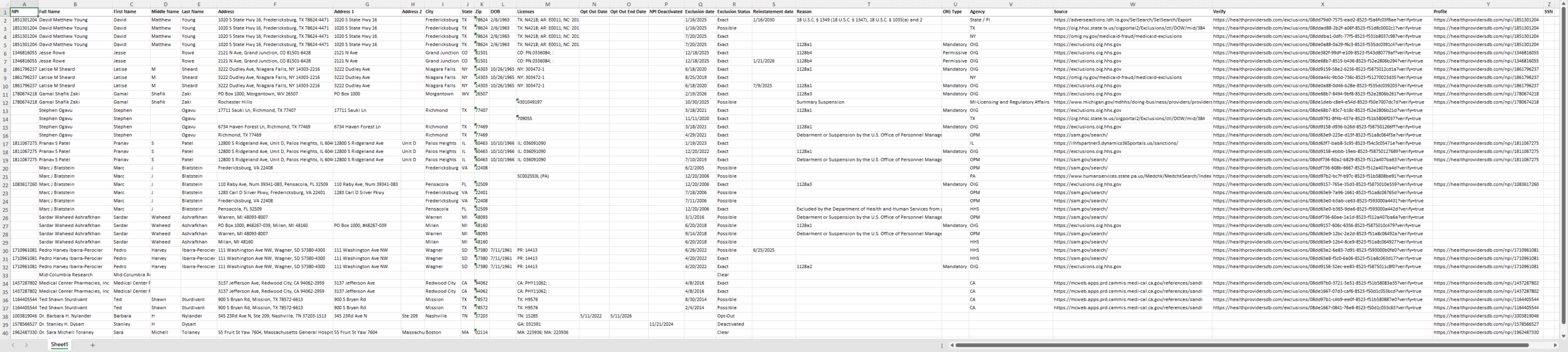
Audit-ready Exclusions Report
The report is audit-ready because it includes complete details about the provider and the reasons for the exclusions. It also includes links to the primary source of the exclusion for verification on the federal or state agency website.
Comprehensive Exclusions Report
- Full Name and Address.
- NPI Number and Deactivation Date.
- License Numbers, Active Status, and Expiration Date.
- Medicare Opt Out Affidavit Start and End Dates.
- The Exclusion Date, Reason, Reinstatement Date, and Status of Exact, Possible, Reinstated, Deactivated, Opted-out, or Clear.
Frequently Asked Questions
Why is Exclusion Screening Essential?
At minimum, monthly screening should include the OIG LEIE and SAM.gov, plus any applicable State Medicaid Provider Termination Lists.
Requirement
Federal database checks—42 CFR Part § 455.436 requires all Medicare Advantage Plans, all State Medicaid Programs, and all Medicaid Managed Care Organizations to confirm through routine Federal database checks the exclusion status of providers.
Compliance
The Office of Inspector General (OIG) mandates screening to prevent fraud, abuse, and patient neglect.
Financial Risk
Hiring an excluded individual can result in substantial Civil Monetary Penalties (CMPs) and repayment obligations.
How often should Exclusion Screening be done?
According to the OIG’s Special Advisory Bulletin issued in May 2013, the OIG recommends that healthcare organizations check their employees and contractors against the LEIE monthly.
42 CFR Part § 455.436(c)(2) Federal database checks states, “check the LEIE and SAM no less frequently than monthly.”
Monthly screening is mandatory in at least 14 States, while many others strongly recommend that providers screen employees and vendors against their State lists and the LEIE monthly.
Who should be screened for Exclusions?
Healthcare organizations must screen all individuals and entities that provide items or services payable by federal health care programs.
This requirement applies to anyone whose work supports services reimbursed by Medicare or Medicaid—whether those services are provided directly or indirectly.
Healthcare Providers & Facilities
Hospitals, nursing homes, home health agencies, clinics, and physician practices.
Personnel
All employees (clinical and non-clinical), pharmacists, pharmacy staff, physicians, nurses, clinical staff, medical assistants, and administrative staff.
Contractors & Vendors
Third-party billing & coding services, transportation providers, ambulance services, and medical equipment suppliers.
Leadership & Support
Board members, managers, owners, and volunteers.
Basically, if an individual’s role contributes in any way to federally reimbursable services, that individual should be included in your OIG exclusion screening and Medicare exclusion monitoring process.
Furthermore, the OIG has emphasized that civil monetary penalties are most likely to be imposed when excluded individuals provide essential services to patient care.
Learn more about who needs to be screened for Medicare Exclusion.