

State Medicaid Exclusion Lists
A complete directory of all state Medicaid Sanctions, Suspensions, Terminations, and Exclusion lists with links to the primary source on the state agency website.
HealthProviders DB imports these lists monthly as they become available, so the Healthcare Provider Profiles are always up to date.
With HealthProviders DB, you can search the OIG-LEIE, SAM, CMS, FDA, NPI, and all state Medicaid exclusion lists at once—for FREE!
Alabama Medicaid Suspended Providers
Alabama Exclusions
This is the total count of Alabama state-reported exclusions. Click to show the total exclusions reported by OIG-LEIE, SAM, and Medicaid exclusions from all other states for Alabama.
Alaska Medical Assistance Excluded Providers
Alaska Exclusions
This is the total count of Alaska exclusions found in the OIG-LEIE, SAM, the Alaska Medicaid exclusion list, and from all other state Medicaid exclusion lists. Click to show only the total Alaska state-reported exclusions.
Arizona Provider Exclusion Suspensions and Terminations
Arizona Exclusions
This is the total count of Arizona exclusions found in OIG-LEIE, SAM, the Alaska Medicaid exclusion list, and all other state Medicaid exclusion lists. Click to show only the total Arizona state-reported exclusions.
Arkansas Medicaid Excluded Providers
Arkansas Exclusions
This is the total count of Arkansas state-reported exclusions. Click to show the total exclusions reported by OIG-LEIE, SAM, and Medicaid exclusions from all other states for Arkansas.
Medi-Cal Suspended and Ineligible Providers
California Exclusions
This is the total count of California state-reported exclusions. Click to show the total exclusions reported by OIG-LEIE, SAM, and Medicaid exclusions from all other states for California.
Colorado Medicaid Terminated Providers
Colorado Exclusions
This is the total count of Colorado exclusions found in OIG-LEIE, SAM, the Colorado Medicaid exclusion list, and all other state Medicaid exclusion lists. Click to show only the total Colorado state-reported exclusions.
Connecticut Quality Assurance Administrative Actions
Connecticut Exclusions
This is the total count of Connecticut exclusions found in OIG-LEIE, SAM, the Connecticut Medicaid exclusion list, and all other state Medicaid exclusion lists. Click to show only the total Connecticut state-reported exclusions.
Delaware Medicaid Sanctioned Providers
Delaware Exclusions
This is the total count of Delaware state-reported exclusions. Click to show the total exclusions reported by OIG-LEIE, SAM, and Medicaid exclusions from all other states for Delaware.
District of Columbia Excluded Parties
DC Exclusions
This is the total count of DC exclusions found in OIG-LEIE, SAM, the DC Medicaid exclusion list, and all other state Medicaid exclusion lists. Click to show only the total DC state-reported exclusions.
Florida Agency for Health Care Administration Public Records
Florida Exclusions
This is the total count of Florida state-reported exclusions. Click to show the total exclusions reported by OIG-LEIE, SAM, and Medicaid exclusions from all other states for Florida.
Georgia Medicaid List of Excluded Individuals
Georgia Exclusions
This is the total count of Georgia state-reported exclusions. Click to show the total exclusions reported by OIG-LEIE, SAM, and Medicaid exclusions from all other states for Georgia.
Hawaii Provider Exclusions & Reinstatements
Hawaii Exclusions
This is the total count of Hawaii exclusions found in the OIG-LEIE, SAM, the Hawaii Medicaid exclusion list, and from all other state Medicaid exclusion lists. Click to show only the total Hawaii state-reported exclusions.
Idaho Medicaid Provider Exclusions
Idaho Exclusions
This is the total count of Idaho exclusions found in the OIG-LEIE, SAM, the Idaho Medicaid exclusion list, and from all other state Medicaid exclusion lists. Click to show only the total Idaho state-reported exclusions.
Illinois Exclusions
This is the total count of Illinois state-reported exclusions. Click to show the total exclusions reported by OIG-LEIE, SAM, and Medicaid exclusions from all other states for Illinois.
Indiana Medicaid Terminated Providers
Indiana Exclusions
This is the total count of Indiana exclusions found in the OIG-LEIE, SAM, the Indiana Medicaid exclusion list, and from all other state Medicaid exclusion lists. Click to show only the total Indiana state-reported exclusions.
Iowa Exclusions
This is the total count of Iowa state-reported exclusions. Click to show the total exclusions reported by OIG-LEIE, SAM, and Medicaid exclusions from all other states for Iowa.
Kansas Medicaid Terminated Providers
Kansas Exclusions
This is the total count of Kansas exclusions found in the OIG-LEIE, SAM, the Kansas Medicaid exclusion list, and from all other state Medicaid exclusion lists. Click to show only the total Kansas state-reported exclusions.
Kentucky Terminated and Excluded Providers
Kentucky Exclusions
This is the total count of Alaska exclusions found in the OIG-LEIE, SAM, the Alaska Medicaid exclusion list, and from all other state Medicaid exclusion lists. Click to show only the total Alaska state-reported exclusions.
Louisiana Exclusions
This is the total count of Louisiana state-reported exclusions. Click to show the total exclusions reported by OIG-LEIE, SAM, and Medicaid exclusions from all other states for Louisiana.
MaineCare List of Excluded Individuals & Entities
Maine Exclusions
This is the total count of Maine state-reported exclusions. Click to show the total exclusions reported by OIG-LEIE, SAM, and Medicaid exclusions from all other states for Maine.
Maryland Medicaid Sanctioned Providers
Maryland Exclusions
This is the total count of Maryland state-reported exclusions. Click to show the total exclusions reported by OIG-LEIE, SAM, and Medicaid exclusions from all other states for Maine.
MassHealth List of Suspended or Excluded Providers
Massachusetts Exclusions
This is the total count of Massachusetts state-reported exclusions. Click to show the total exclusions reported by OIG-LEIE, SAM, and Medicaid exclusions from all other states for Massachusetts.
Michigan Medicaid Sanctioned Providers
Michigan Exclusions
This is the total count of Michigan state-reported exclusions. Click to show the total exclusions reported by OIG-LEIE, SAM, and Medicaid exclusions from all other states for Michigan.
Minnesota Health Care Programs Excluded Individual Providers
Minnesota Exclusions
This is the total count of Minnesota state-reported exclusions. Click to show the total exclusions reported by OIG-LEIE, SAM, and Medicaid exclusions from all other states for Minnesota.
Mississippi Sanctioned Providers
Mississippi Exclusions
This is the total count of Mississippi exclusions found in the OIG-LEIE, SAM, the Mississippi Medicaid exclusion list, and from all other state Medicaid exclusion lists. Click to show only the total Mississippi state-reported exclusions.
Missouri Exclusions
This is the total count of Missouri state-reported exclusions. Click to show the total exclusions reported by OIG-LEIE, SAM, and Medicaid exclusions from all other states for Missouri.
Montana Medicaid Excluded and Terminated Providers
Montana Exclusions
This is the total count of Montana exclusions found in the OIG-LEIE, SAM, the Montana Medicaid exclusion list, and from all other state Medicaid exclusion lists. Click to show only the total Montana state-reported exclusions.
Nebraska Medicaid Excluded Providers
Nebraska Exclusions
This is the total count of Nebraska state-reported exclusions. Click to show the total exclusions reported by OIG-LEIE, SAM, and Medicaid exclusions from all other states for Nebraska.
Nevada Provider Exclusions & Sanctions
Nevada Exclusions
This is the total count of Nevada state-reported exclusions. Click to show the total exclusions reported by OIG-LEIE, SAM, and Medicaid exclusions from all other states for Nevada.
New Hampshire Medicaid Provider Exclusions and Sanctions
New Hampshire Exclusions
This is the total count of New Hampshire exclusions found in the OIG-LEIE, SAM, the New Hampshire Medicaid exclusion list, and from all other state Medicaid exclusion lists. Click to show only the total New Hampshire state-reported exclusions.
New Jersey Medicaid Ineligible Providers
New Jersey Exclusions
This is the total count of New Jersey state-reported exclusions. Click to show the total exclusions reported by OIG-LEIE, SAM, and Medicaid exclusions from all other states for New Jersey.
New Mexico does not maintain a state exclusion list.
New Mexico Exclusions
This is the total New Mexico exclusions found in OIG-LEIE, SAM, and all other state Medicaid exclusion lists.
New York Exclusions
This is the total count of New York state-reported exclusions. Click to show the total exclusions reported by OIG-LEIE, SAM, and Medicaid exclusions from all other states for New York.
North Carolina Medicaid Provider Terminations and Exclusions
North Carolina Exclusions
This is the total count of North Carolina state-reported exclusions. Click to show the total exclusions reported by OIG-LEIE, SAM, and from all other state Medicaid exclusions for North Carolina.
North Dakota Medicaid Provider Exclusions
North Dakota Exclusions
This is the total count of North Dakota exclusions found in the OIG-LEIE, SAM, the North Dakota Medicaid exclusion list, and from all other state Medicaid exclusion lists. Click to show only the total North Dakota state-reported exclusions.
Ohio Medicaid Provider Exclusions & Suspensions
Ohio Exclusions
This is the total count of Ohio state-reported exclusions. Click to show the total exclusions reported by OIG-LEIE, SAM, and all other state Medicaid exclusions for Ohio.
Oklahoma does not maintain a state exclusion list.
Oklahoma Exclusions
This is the total Oklahoma exclusions found in OIG-LEIE, SAM, and all other state Medicaid exclusion lists.
Oregon Medicaid Fraud Convictions
Oregon Exclusions
This is the total count of Oregon exclusions found in the OIG-LEIE, SAM, the Oregon Medicaid exclusion list, and all other state Medicaid exclusion lists. Click to show only the total Oregon state-reported exclusions.
Pennsylvania Medicheck Precluded Providers
Pennsylvania Exclusions
This is the total count of Pennsylvania state-reported exclusions. Click to show the total exclusions reported by OIG-LEIE, SAM, and all other state Medicaid exclusions for Pennsylvania.
Rhode Island does not maintain a state exclusion list.
Rhode Island Exclusions
This is the total Rhode Island exclusions found in OIG-LEIE, SAM, and all other state Medicaid exclusion lists.
South Carolina Medicaid Excluded & Terminated Providers
South Carolina Exclusions
This is the total count of South Carolina state-reported exclusions. Click to show the total exclusions reported by OIG-LEIE, SAM, and all other state Medicaid exclusions for South Carolina.
South Dakota does not maintain a state exclusion list.
South Dakota Exclusions
This is the total South Dakota exclusions found in OIG-LEIE, SAM, and all other state Medicaid exclusion lists.
Tennessee Program Integrity Terminated Providers
Tennessee Exclusions
This is the total count of Tennessee exclusions found in the OIG-LEIE, SAM, the Tennessee Medicaid exclusion list, and from all other state Medicaid exclusion lists. Click to show only the total Tennessee state-reported exclusions.
Texas Medicaid Provider Exclusions
Texas Exclusions
This is the total count of Texas state-reported exclusions. Click to show the total exclusions reported by OIG-LEIE, SAM, and all other state Medicaid exclusions for Texas.
Utah does not maintain a state exclusion list.
Utah Exclusions
This is the total Utah exclusions found in OIG-LEIE, SAM, and all other state Medicaid exclusion lists.
Vermont Medicaid Excluded Providers
Vermont Exclusions
This is the total count of Vermont exclusions found in the OIG-LEIE, SAM, the Vermont Medicaid exclusion list, and all other state Medicaid exclusion lists. Click to show only the total Vermont state-reported exclusions.
Virginia does not maintain a state exclusion list.
Virginia Exclusions
This is the total Virginia exclusions found in OIG-LEIE, SAM, and all other state Medicaid exclusion lists.
Washington Health Care Authority Provider Terminations and Exclusions
Washington Exclusions
This is the total count of Washington exclusions found in the OIG-LEIE, SAM, the Washington Medicaid exclusion list, and all other state Medicaid exclusion lists. Click to show only the total Washington state-reported exclusions.
West Virginia Provider Exclusions and Terminations
West Virginia Exclusions
This is the total count of West Virginia exclusions found in the OIG-LEIE, SAM, the West Virginia Medicaid exclusion list, and from all other state Medicaid exclusion lists. Click to show only the total West Virginia state-reported exclusions.
Wisconsin does not maintain a state exclusion list.
Wisconsin Exclusions
This is the total Wisconsin exclusions found in OIG-LEIE, SAM, and all other state Medicaid exclusion lists.
How are State Medicaid Exclusion Lists different from the OIG-LEIE?
States must notify the Health and Human Services (HHS) Office of Inspector General (OIG) of actions taken on a provider for violations of federal law. States are not required to notify the OIG of actions taken on a provider for violations of state laws. This is because if the state action does not meet federal exclusion criteria, the OIG will not include it in the OIG-LEIE.
For instance, a state might exclude someone or an entity for failing to pay state taxes or for other reasons that would not meet federal exclusion criteria. For this reason, states maintain lists of individuals and entities that are terminated, suspended, sanctioned, or otherwise excluded from the state Medicaid program.
Do state exclusion lists include the same information as the OIG-LEIE?
You’d think we would have a standard for something this important, but sadly, no. Information in state exclusion lists can vary widely, with some including little more than a name and address. Some state lists are in Excel format, others in Word or PDF, and some are simply HTML web pages.
HealthProviders DB brings together all state and federal databases into one cohesive platform, making access to healthcare information easier and more efficient!
Why do some states not keep an exclusion list?
States are not required to maintain a state exclusion list.
New Mexico, Oklahoma, Rhode Island, South Dakota, Utah, Virginia, and Wisconsin do not maintain a state Medicaid exclusion list.
HealthProviders DB collects and aggregates exclusions from all state Medicaid exclusion lists, the Office of Inspector General’s List of Excluded Individuals/Entities (OG-LEIE), and the System for Award Management (SAM). So although there is no state exclusion list, you can search HealthProviders DB for exclusions in those states.
Why do I need to screen against all state exclusion lists?
Section 6501 of the Affordable Care Act (ACA), Termination of Provider Participation Under Medicaid if Terminated Under Medicare or Other State Plan, requires State Medicaid programs and the Children’s Health Insurance Program (CHIP) to terminate the participation of any individual or entity that has been terminated from Medicare by CMS or any other State’s Medicaid program for cause.
This provision is intended to enhance program integrity by ensuring that federal funds do not reach providers excluded for serious offenses, such as fraud or abuse, regardless of the originating state’s termination.

Do You Need a One-Time Exclusion Screening?
One-time Exclusion Screening is a healthcare compliance batch exclusion screening service that compares your list of healthcare providers against the OIG LEIE, SAM, CMS, NPI, FDA, and State Medicaid exclusion lists, delivering a consolidated & comprehensive downloadable exclusion screening report—starting at just $25 for up to 100 providers screened.
One-time Exclusions Screening is useful for new provider onboarding, credentialing, vendor screening, or periodic compliance checks. It’s ideal for small organizations with a limited number of providers that want to verify exclusions and gather documented evidence themselves.
One-time Exclusions Screening is used for:
- New provider onboarding
- A compliance review
- An internal audit
- Credentialing
- Enrollment
- Vendor screening
- Contracting
- Periodic compliance checks
- A specific provider population

Do You Need Continuous Exclusion Monitoring?
Continuous Exclusion Monitoring automatically checks your monitored provider list against updated exclusion data as new source data becomes available and notifies you when a provider’s exclusion status changes.
Continuous Exclusion Monitoring Features include:
- Easily manage your list of all healthcare providers, employees, vendors, and contractors for continual exclusion monitoring.
- Automatic monthly updates imported from OIG, SAM, and State Medicaid Exclusion Lists and matched to your provider list.
- Automatic Exclusions Change Notifications.
- Comprehensive, always-current, and audit-ready Exclusions Report available for download anytime.
- Exclusions Dashboard with total Providers, Exclusions, Verifications, Reinstatements, Medicare Opt-out, and NPI deactivations.
- Built-in Exclusion Primary Source Verification Tools.
- Save Notes & Documented Evidence of Exclusion Screening.
One-time Screening vs. Continuous Exclusion Monitoring
| One-Time Screening | Continuous Monitoring | |
|---|---|---|
| Best for | Occasional screening | Ongoing compliance |
| Provider list | Upload when needed | Continuously maintained |
| OIG LEIE | ✓ | ✓ |
| SAM | ✓ | ✓ |
| State Medicaid | ✓ | ✓ |
| Recurring monitoring | — | ✓ |
| Automatic change alerts | — | ✓ |
| Monitoring dashboard | — | ✓ |
| Saved screening evidence | — | ✓ |
| Price | $25/100 providers | $89 Monthly subscription |
What Databases Are Checked?
HealthProviders DB is a national healthcare provider database with over 9 million profiles—updated daily directly from publicly available state and federal databases—including the complete NPI database & deactivated numbers list, OIG LEIE, SAM, CMS Revoked Medicare Providers & Medicare Opt-out, all State Medicaid Sanctions, Suspensions, Terminations, and Exclusion lists, plus state license active status, and state licensing board disciplinary actions, FDA debarments, and Clinical Investigator Disqualifications.
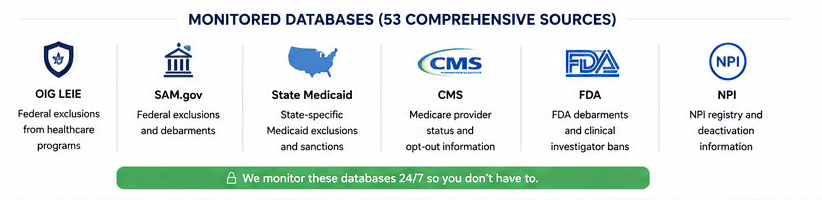
| Database | What it identifies |
|---|---|
| OIG LEIE | Individuals and entities excluded from federal healthcare programs |
| SAM.gov | Federal exclusions and debarments |
| State Medicaid | State-specific Medicaid exclusions, terminations, and sanctions |
| State Licenses | State-specific licensing and disciplinary actions |
| CMS | Medicare opt-outs and revoked providers |
| FDA | FDA debarments and clinical investigator disqualifications |
| NPI | NPI deactivation status |
Frequently Asked Questions
Who should be included in Exclusion Screening?
Healthcare organizations must screen all individuals and entities that provide items or services payable by federal health care programs. This requirement applies to anyone whose work supports services reimbursed by Medicare or Medicaid—whether those services are provided directly or indirectly.
Healthcare Providers & Facilities
Hospitals, nursing homes, home health agencies, clinics, and physician practices.
Personnel
All employees (clinical and non-clinical), pharmacists, pharmacy staff, physicians, nurses, clinical staff, medical assistants, and administrative staff.
Contractors & Vendors
Third-party billing & coding services, transportation providers, ambulance services, and medical equipment suppliers.
Leadership & Support
Board members, managers, owners, and volunteers.
Basically, if an individual’s role contributes in any way to federally reimbursable services, that individual should be included in your OIG exclusion screening and Medicare exclusion monitoring process.
What happens when an exclusion for the provider is found?
You should verify and document all matches, as evidence of provider screening, for audit review. Pay special attention to potential matches by name only and verify against other identifying information such as NPI, name, address, and license information. You can find detailed provider information in the HealthProviders DB provider profile. The Exclusions Report includes a link to the provider’s profile.
Verify the exclusion with the primary-source government record and document the findings. Confirm whether the exclusion matches the primary-source record or is a false positive; either way, document your findings. HealthProviders DB includes a link to the primary-source exclusion record for each match in the Exclusion Report to help with verification.
The HealthProviders DB Continuous Exclusions Monitoring subscription lets you save exclusion screening verification notes and documents with the provider exclusion, and they are included with the Exclusions Report for audit review.
You should review the Updated Special Advisory Bulletin on the Effect of Exclusion from Participation in Federal Health Care Programs for additional guidance. If you find a confirmed exclusion match for an already employed individual or contractor, you should review the Self-Disclosure Protocol to help minimize any potential CMP.
Organizations should follow their compliance procedures and applicable requirements.
Can a name match be a false positive?
Yes. A name match alone does not necessarily mean that a provider is excluded. Review potential matches using additional identifying information such as NPI, name, address, and license information, and verify them against the applicable primary-source record.
Can I monitor employees and contractors?
Yes. You can use continuous monitoring for employees, contractors, and other individuals or entities your organization has determined should be included in its exclusion-screening process.
Can I monitor vendors?
Yes. Organizations can include vendors and other business relationships when those parties fall within the organization’s screening requirements. The appropriate scope depends on the organization’s programs, contracts, payer requirements, and applicable laws and regulations.
Can I verify an exclusion against the original government source?
Yes. HealthProviders DB provides links to applicable primary-source records so you can investigate potential matches and verify them against the underlying government source before your organization takes action.
Can I document what I did after reviewing a potential exclusion?
Yes. HealthProviders DB lets you save screening notes and documented verification evidence with the provider exclusion, and these are included in the exclusion report, helping your organization maintain a record of its screening and verification activity.
What information is included in the Exclusions Report?
The Exclusions Report includes provider name and address, NPI and deactivation information, license information, Medicare opt-out information, exclusion dates and reasons, reinstatement information, match status, and links to primary-source records for verification.
Can I start with one-time screening and switch to continuous monitoring?
Yes. A one-time screening can establish an initial baseline for a provider population. If your organization then needs ongoing monitoring, it can use the provider list for continuous exclusion monitoring to identify subsequent changes.
Does continuous monitoring replace my organization’s compliance program?
No. Continuous exclusion monitoring is a screening and monitoring tool. It does not replace your organization’s compliance policies, legal obligations, credentialing procedures, or professional judgment. Organizations should determine which individuals and entities need screening and what actions are required when they identify a potential exclusion or other status change.
What if I need help?
We are here to help you. Contact us with any questions and support you need. We can help you upload your provider list and show you how to use the verification tools to verify exclusions and document your screening evidence.
Resources
Code of Federal Regulations (CFRs) applicable to Program Integrity (not an all-inclusive list):
- 42 CFR 438 – Managed Care
- 42 CFR 455 – Program Integrity: Medicaid
- 42 CFR 456 – Utilization Control
- 42 CFR 1001 – Program Integrity – Medicare and State Health Care Programs
- 42 CFR 1002 – Program Integrity – State Initiated exclusions from Medicaid
- 42 CFR 1007 – State Medicaid Fraud Control Units
HealthProviders DB provides data and screening services to assist organizations with exclusion screening and compliance processes. Organizations should independently review and verify screening results, especially when a potential match is identified. The service does not constitute legal, regulatory, or compliance advice and does not guarantee that an organization will satisfy its legal or regulatory obligations.