

Continuous Exclusion Monitoring for Healthcare Compliance
Continually monitor your entire list of healthcare providers, employees, vendors, and contractors for OIG LEIE, SAM, CMS, FDA, NPI, and all State Medicaid exclusions—Get automatic Exclusion Alerts • Save documented screening & verification evidence • Audit-ready Exclusions Report.
Continuous Exclusion Monitoring—$89 / Month
No contract / Cancel anytime
- Continuous Exclusion Monitoring
- Automatic Exclusion Notifications
- Exclusion Monitoring Dashboard
- Primary-source Verification
- Audit-ready Reports
- Save screening notes and documented evidence
- Provider list management
Continuous Exclusion Monitoring — Quick Answers
What is continuous exclusion monitoring?
Continuous OIG exclusion monitoring is an ongoing process of checking healthcare providers, employees, contractors, and other monitored individuals or entities against exclusion and provider-status data sources. When a relevant change is identified, the organization can receive a notification and review the result.
Why is continuous exclusion monitoring important?
A provider who was eligible when hired or contracted can later become excluded. Continuous monitoring helps organizations identify changes after the initial screening, rather than relying solely on a one-time check. OIG recommends screening employees and contractors before employment or contracting and periodically thereafter. OIG also states that monthly screening best minimizes potential overpayment and civil monetary penalty liability because the LEIE is updated monthly.
What does HealthProviders DB monitor?
HealthProviders DB monitors your provider list against federal and state exclusion and provider-status data sources. See What Does Continuous Exclusion Monitoring Check? below for the specific sources monitored.
How are customers notified of changes?
When HealthProviders DB identifies a monitored exclusion or other tracked status change, it sends an automatic notification so the organization can review the provider and investigate the underlying source information.
How much does continuous exclusion monitoring cost?
Continuous exclusion monitoring is $89/month with no long-term contract and the ability to cancel at any time.
How Continuous Exclusion Monitoring Works

What you get with Continuous Exclusion Monitoring
With the Continuous Exclusion Monitoring subscription, you can easily add and remove providers, employees, vendors, and contractors for ongoing exclusion monitoring. The consolidated & comprehensive Exclusions Report is always current and accessible anytime through the Exclusions Dashboard. You can also save notes and documented verification evidence with each exclusion for audit review.
Automatic Change Notifications
Know when something changes without manually checking every provider.
Centralized Monitoring Dashboard
See your monitored providers, exclusions, verifications, reinstatements, Medicare opt-outs, and NPI deactivations in one place. You’ll also know how many exclusions have been verified and how many still require verification.
Primary-Source Verification
Review the underlying federal or state exclusion at the primary source. The Exclusions Report includes a link to the exclusion’s primary source on the reporting agency website for verification.
Audit-Ready Documentation
Maintain reports, notes, and supporting evidence of your screening activity.
Easy Provider Management
Add, remove, or update providers as your workforce and contractor relationships change.

Why Continuous Exclusion Monitoring Matters
Catch changes without manually checking every provider
Exclusions and provider-status information can change after a provider has already been hired or contracted. OIG advises healthcare entities to check the LEIE routinely and notes that monthly screening best minimizes potential overpayment and CMP liability, as the OIG updates the LEIE monthly.
Reduce manual compliance work.
Instead of repeatedly downloading databases and manually checking provider records, maintain a monitored list and receive notifications when relevant changes are identified.
Maintain documentation
Keep screening results, verification information, notes, and evidence available for compliance and audit purposes.
Know what changed
The dashboard should make it easy to distinguish exclusions, possible matches, reinstatements, deactivations, and other monitored statuses.
Avoid Civil Monetary Penalties
Providers excluded by the Office of Inspector General (OIG), terminated by any State Medicaid Agency, or debarred from receiving federal contracts, grants, or financial assistance cannot participate in federally funded healthcare programs. This includes Medicare, Medicaid, TRICARE, and the Children’s Health Insurance Program (CHIP). Additionally, the Centers for Medicare & Medicaid Services (CMS) can revoke billing privileges, prohibiting the provider from participating in Medicare.
Providers are liable for overpayments made for any items or services provided by any excluded person for which the provider received reimbursement from federal healthcare programs. Additionally, the provider may face Civil Monetary Penalties (CMP) if it fails to ensure proper exclusion screening.
What Does Continuous Exclusion Monitoring Check?
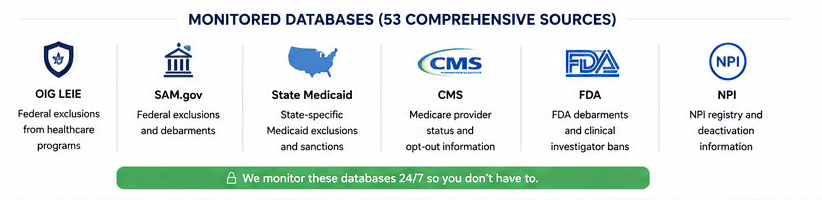
HealthProviders DB is a national healthcare provider database with over 9 million profiles—updated daily directly from publicly available state and federal databases—including the complete NPI database & deactivated numbers list, OIG LEIE, SAM, CMS Revoked Medicare Providers & Medicare Opt-out, all State Medicaid Sanctions, Suspensions, Terminations, and Exclusion lists, plus state license active status, and state licensing board disciplinary actions, FDA debarments, and Clinical Investigator Disqualifications.
| Database | What it identifies |
|---|---|
| OIG LEIE | Individuals and entities excluded from federal healthcare programs |
| SAM.gov | Federal exclusions and debarments |
| State Medicaid | State-specific Medicaid exclusions, terminations, and sanctions |
| State Licenses | State-specific licensing and disciplinary actions |
| CMS | Medicare opt-outs and revoked providers |
| FDA | FDA debarments and clinical investigator disqualifications |
| NPI | NPI deactivation status |
Who Needs Continuous Exclusion Monitoring?
Organizations that employ, contract with, or otherwise work with individuals and entities whose services may be paid for by federal healthcare programs; this includes:
- Hospitals & Health Systems
- Physician Practices
- Nursing & Long-Term Care
- Home Health & Hospice
- Ambulatory Surgery Centers
- Pharmacies
- Medical Equipment Suppliers
- Billing & Coding Companies
- Healthcare Contractors
- Managed Care Organizations
Continuous Monitoring Is Ideal For Organizations That:
- Participate in Medicare or Medicaid
- Need documented compliance processes
- Don’t want staff manually checking exclusion databases every month
- Use temporary or contract healthcare workers
- Work with outside vendors
- Operate multiple locations
- Have recurring provider turnover
An Exclusions Report You Can Actually Use
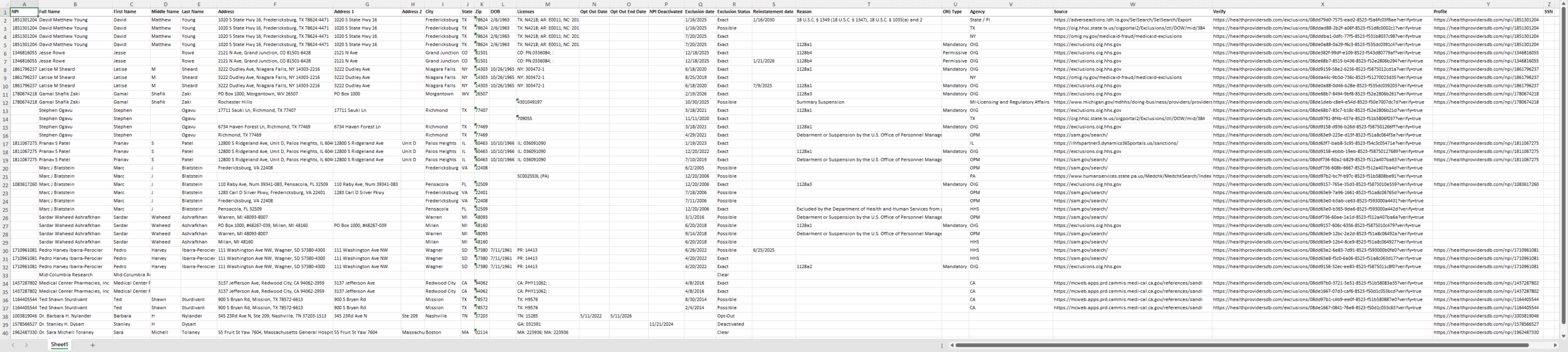
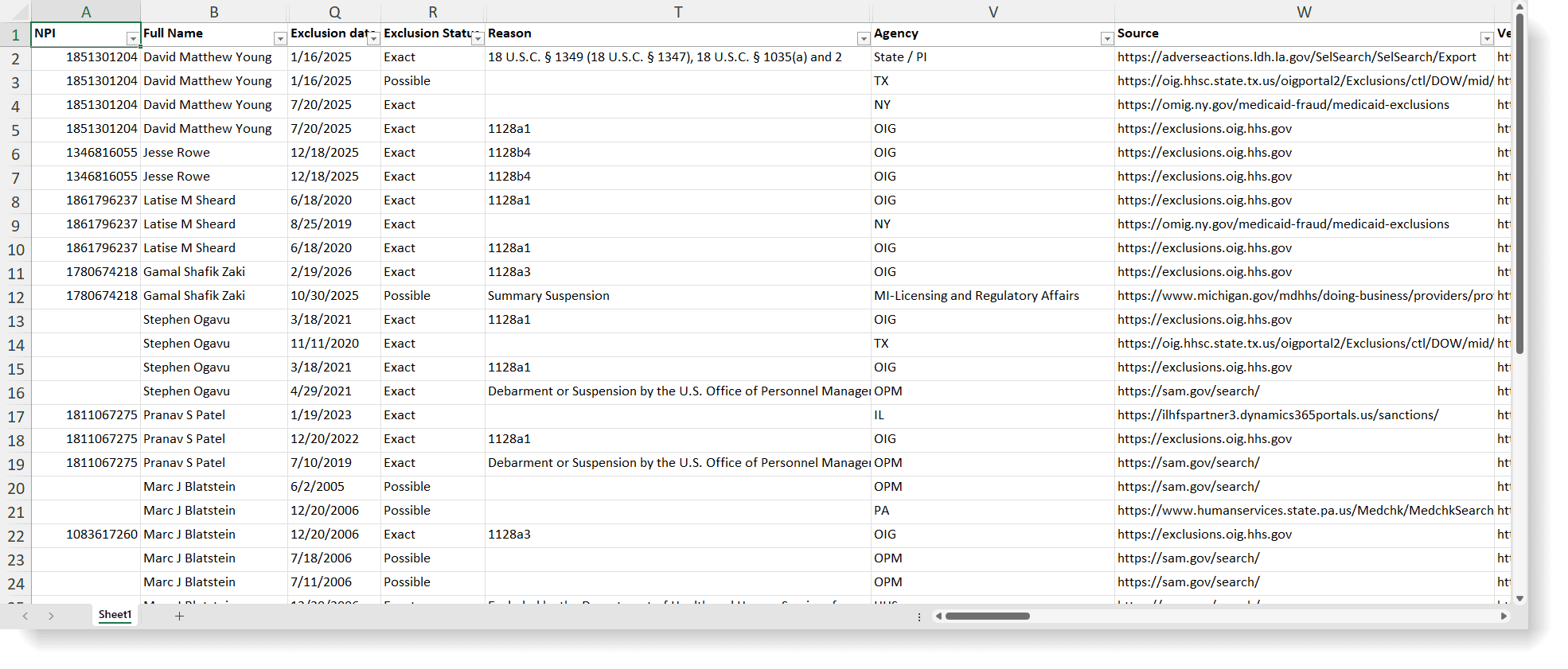
The Exclusions Report is designed to give you a consolidated view of your provider screening results, including the information needed to investigate and verify the exclusion matches.
The Exclusions Report includes:
- The provider’s full name and Addresses for identity and location matching.
- NPI Number and Deactivation Date for identity matching and active status checks.
- License Numbers, Active Status, and Expiration Date for license verification and current status review.
- Medicare Opt-Out Affidavit Start and End Dates for assessing Medicare participation status.
- Exclusion Date, Reason, Reinstatement Date, and Status of Exact, Possible, Reinstated, Deactivated, Opted-out, or Clear for identification and verification.
- Links to the exclusion primary source record on the reporting agency’s website for verification and collecting documented evidence.
Sample Exclusions Report
What should I do with the exclusion matches?
Do not treat a screening result as a final determination. Verify all matches and collect documented evidence that you screened the provider. Even exact matches found by NPI number or by full name and address require verification and documentation of verification.
Documenting your screening due diligence is essential for every new hire, existing employee, and contractor. The Continuous Exclusion Monitoring subscription lets you save documentation with the provider exclusion.
The Exclusions Screening Report makes exclusion verification a breeze! By connecting you to primary source records on the reporting agency’s website, it streamlines quick verification and evidence gathering. With the Exclusion Report and your documentation, you’ll be all set for audits!
What to do with exact matches
Verify and document exact matches using the link provided to the exclusion’s primary source on the reporting agency’s website. An exact match is by NPI number or by full name, address, and primary specialty. Use the link provided in the Exclusion Report to gather documented evidence of your due diligence.
What to do with possible matches
Reviewing possible matches by name only is more difficult. You use the same verification tools to verify the exclusion on the reporting agency website. Additionally, you can also verify using identifying information such as NPI, name, address, and license number in the provider’s detailed profile on HealthProviders DB.
What to do with opt-out matches
Healthcare providers that have opted out of Medicare cannot receive Medicare reimbursements. Opted-out matches have start and end dates. Use the primary source link to obtain the Medicare Opt-out affidavit.
What to do with deactivated NPI matches.
Deactivated NPI matches mean the number is no longer valid. Use the primary source link to get evidence from the NPI registry.
Need a One-Time Exclusion Screening Instead?
One-time Exclusion Screening is a healthcare compliance batch exclusion screening service that compares your list of healthcare providers against the OIG LEIE, SAM, CMS, NPI, FDA, and State Medicaid exclusion lists, delivering a consolidated & comprehensive downloadable exclusion screening report—starting at just $25 for up to 100 providers screened.
One-time Exclusions Screening is useful for new provider onboarding, credentialing, vendor screening, or periodic compliance checks. It’s ideal for small organizations with a limited number of providers that want to verify exclusions and gather documented evidence themselves.
One-time Exclusions Screening is used for:
- New provider onboarding
- A compliance review
- An internal audit
- Credentialing
- Enrollment
- Vendor screening
- Contracting
- Periodic compliance checks
- A specific provider population
One-time Screening vs. Continuous Exclusion Monitoring
| One-Time Screening | Continuous Monitoring | |
|---|---|---|
| Best for | Occasional screening | Ongoing compliance |
| Provider list | Upload when needed | Continuously maintained |
| OIG LEIE | ✓ | ✓ |
| SAM | ✓ | ✓ |
| State Medicaid | ✓ | ✓ |
| Recurring monitoring | — | ✓ |
| Automatic change alerts | — | ✓ |
| Monitoring dashboard | — | ✓ |
| Saved screening evidence | — | ✓ |
| Price | $25/100 providers | $89 Monthly subscription |
Frequently Asked Questions
What happens if a provider becomes excluded after I have already screened them?
A one-time screening only reflects the information available when the screening is performed. Continuous monitoring is designed to identify subsequent exclusion and provider-status changes so your organization can review them when they occur.
How quickly will I be notified of an exclusion?
HealthProviders DB provides automatic notifications when it identifies a monitored exclusion change. The notification allows your organization to review the provider’s record and investigate the underlying source information.
Can a name match be a false positive?
Yes. A name match alone does not necessarily mean that a provider is excluded. Review potential matches using additional identifying information such as NPI, name, address, and license information, and verify them against the applicable primary-source record.
Can I monitor employees and contractors?
Yes. You can use continuous monitoring for employees, contractors, and other individuals or entities your organization has determined should be included in its exclusion-screening process.
Can I monitor vendors?
Yes. Organizations can include vendors and other business relationships when those parties fall within the organization’s screening requirements. The appropriate scope depends on the organization’s programs, contracts, payer requirements, and applicable laws and regulations.
Can I verify an exclusion against the original government source?
Yes. HealthProviders DB provides links to applicable primary-source records so you can investigate potential matches and verify them against the underlying government source before your organization takes action.
Can I document what I did after reviewing a potential exclusion?
Yes. HealthProviders DB lets you save screening notes and documented verification evidence with the exclusion report, helping your organization maintain a record of its screening and review activity.
What information is included in the Exclusions Report?
The Exclusions Report includes provider name and address, NPI and deactivation information, license information, Medicare opt-out information, exclusion dates and reasons, reinstatement information, match status, and links to primary-source records for verification.
Can I start with one-time screening and switch to continuous monitoring?
Yes. A one-time screening can establish an initial baseline for a provider population. If your organization then needs ongoing monitoring, it can use the provider list for continuous exclusion monitoring to identify subsequent changes.
Does continuous monitoring replace my organization’s compliance program?
No. Continuous exclusion monitoring is a screening and monitoring tool. It does not replace your organization’s compliance policies, legal obligations, credentialing procedures, or professional judgment. Organizations should determine which individuals and entities need screening and what actions are required when they identify a potential exclusion or other status change.
HealthProviders DB provides data and screening services to assist organizations with exclusion screening and compliance processes. Organizations should independently review and verify screening results, especially when a potential match is identified. The service does not constitute legal, regulatory, or compliance advice and does not guarantee that an organization will satisfy its legal or regulatory obligations.