

Instantly search SAM Exclusions, OIG Exclusions, and all State Medicaid Exclusions Lists at once by NPI Number, Name, or License Number.
Providers excluded by the Office of Inspector General (OIG), terminated by any State Medicaid Agency, or debarred from receiving federal contracts, grants, or financial assistance cannot participate in federally funded healthcare programs. This includes Medicare, Medicaid, TRICARE, and the Children’s Health Insurance Program (CHIP). Additionally, the Centers for Medicare & Medicaid Services (CMS) can revoke billing privileges, prohibiting the provider from participating in Medicare.
Providers are liable for overpayments made for any items or services provided by any excluded person for which the provider received reimbursement from federal healthcare programs. Additionally, the provider may face Civil Monetary Penalties (CMP) if it fails to ensure proper exclusion screening.
Why is it necessary to screen both OIG Exclusions and SAM Debarments?
Both OIG Exclusions and SAM Debarments are required because they serve distinct, though overlapping, purposes in protecting federal funds and programs.
OIG (Office of Inspector General) exclusions target individuals/entities prohibited from participating in Medicare and Medicaid. Whereas, SAM (System for Award Management) debarments cover broader exclusions from all federal contracts, grants, and loans.
- Different Scope & Authority: OIG focuses on healthcare fraud/patient harm. SAM covers a wider range of actions, including non-healthcare fraud, tax delinquency, and national security violations.
- No One-to-One Overlap: An individual might be excluded from Medicare by the OIG but not yet listed in SAM, or vice versa (e.g., a contractor debarred from federal construction projects for fraud who then applies to a clinic).
- Legal Compliance and Penalties: Federal law prohibits using federal funds (Medicare/Medicaid) to pay any excluded provider. Hiring or contracting with an entity listed on either database can result in severe civil monetary penalties (CMPs) and loss of funding.
- Completeness: While the OIG’s List of Excluded Individuals and Entities (LEIE) is specific, SAM often includes actions from multiple federal agencies, making it a more comprehensive federal screening tool overall.
In short, auditing both databases is necessary to ensure complete compliance and avoid liability, as they are not always synchronized, and a “clean” record on one does not guarantee exclusion from the other.
Search SAM Exclusions
HealthProviders DB is an extensive healthcare provider and exclusions database featuring over 9 million comprehensive Healthcare Provider Profiles.
The System for Award Management Exclusions (SAM.gov) is imported monthly as it becomes available, so the Healthcare Provider Profiles are always up to date.
Enter an NPI number, license number, or provider name in the search field below to search SAM Exclusions or All Exclusions.
Alternatively, you can also search the Provider Profiles.
One Upload. Multiple Exclusion Checks.
OIG LEIE
List of Excluded Individuals/Entities
SAM.gov
Federal debarments and exclusions
State Medicaid
State exclusion/termination lists
FDA
Debarments and clinical investigator disqualifications
CMS
Medicare opt-outs and revoked providers
Simple, Pay-As-You-Screen Pricing
$25 per 100 providers
That’s only 25¢ per provider
✓ Comprehensive screening report
✓ Primary-source verification tools
✓ No subscription
✓ No account required
How Exclusions Screening Works
1. Upload Your Provider List
Upload an Excel or text file containing the NPI numbers or provider names you want screened.
2. We Screen Your Providers
Your list is checked against multiple exclusion and federal databases.
3. Review Your Results
Receive an email with a link to your screening report.
4. Pay & Download
Pay based on the number of providers screened and download your report. The Exclusions Report automatically downloads after payment.
See Exactly How Provider Screening Works
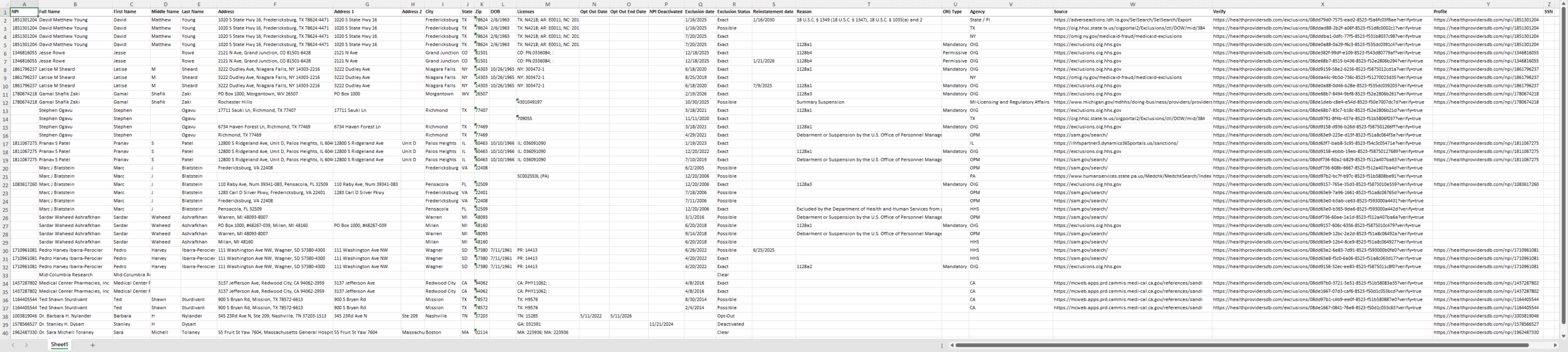
Audit-ready Exclusions Report
The report is audit-ready because it includes complete details about the provider and the reasons for the exclusions. It also includes links to the primary source of the exclusion for verification on the federal or state agency website.
Comprehensive Exclusions Report
- Full Name and Address.
- NPI Number and Deactivation Date.
- License Numbers, Active Status, and Expiration Date.
- Medicare Opt Out Affidavit Start and End Dates.
- The Exclusion Date, Reason, Reinstatement Date, and Status of Exact, Possible, Reinstated, Deactivated, Opted-out, or Clear.
Frequently Asked Questions
Requirement
Federal database checks—42 CFR Part § 455.436 requires all Medicare Advantage Plans, all State Medicaid Programs, and all Medicaid Managed Care Organizations to confirm through routine Federal database checks the exclusion status of providers.
Compliance
The Office of Inspector General (OIG) mandates screening to prevent fraud, abuse, and patient neglect.
Financial Risk
Hiring an excluded individual can result in substantial Civil Monetary Penalties (CMPs) and repayment obligations.
According to the OIG’s Special Advisory Bulletin issued in May 2013, the OIG recommends that healthcare organizations check their employees and contractors against the LEIE monthly.
42 CFR Part § 455.436(c)(2) Federal database checks states to “check the LEIE and SAM no less frequently than monthly.”
Monthly screening is mandatory in at least 14 States, while many others strongly recommend that providers screen employees and vendors against their State lists and the LEIE monthly.
Healthcare organizations must conduct exclusion screening for all individuals and entities that provide items or services payable by federal health care programs.
This requirement applies to anyone whose work supports services reimbursed by Medicare or Medicaid—whether those services are provided directly or indirectly.
Healthcare Providers & Facilities
Hospitals, nursing homes, home health agencies, clinics, and physician practices.
Personnel
All employees (clinical and non-clinical), pharmacists, pharmacy staff, physicians, nurses, clinical staff, medical assistants, and administrative staff.
Contractors & Vendors
Third-party billing & coding services, transportation providers, ambulance services, and medical equipment suppliers.
Leadership & Support
Board members, managers, owners, and volunteers.
Basically, if an individual’s role contributes in any way to federally reimbursable services, that individual should be included in your OIG exclusion screening and Medicare exclusion monitoring process.
Furthermore, the OIG has emphasized that civil monetary penalties are most likely when excluded individuals provide essential services to patient care.