
HealthProviders DB is a comprehensive database of healthcare providers, including a complete directory of all Amputee Clinics & Centers.
Clinic/Center Healthcare Taxonomy Code 261QA0900X
As of today, the following are the total number of Amputee Clinics & Centers nationally, in your State, and near your location.
Select a State below to view the list by State. Additionally, you can narrow the list by city, among other options, from the Filter Panel, which you can open by clicking the vertical ellipses ⋮ in the upper right corner of the app.
Alaska – Alabama – Armed Forces Pacific – Arkansas – American Samoa – Arizona – California – Colorado – Connecticut – District of Columbia – Delaware – Florida – Federated States of Micronesia – Georgia – Guam – Hawaii – Iowa – Idaho – Illinois – Indiana – Kansas – Kentucky – Louisiana – Massachusetts – Maryland – Maine – Marshall Islands – Michigan – Minnesota – Missouri – Northern Mariana Islands – Mississippi – Montana – North Carolina – North Dakota – Nebraska – New Hampshire – New Jersey – New Mexico – Nevada – New York – Ohio – Oklahoma – Oregon – Pennsylvania – Puerto Rico – Palau – Rhode Island – South Carolina – South Dakota – Tennessee – Texas – Utah – Virginia – Virgin Islands – Vermont – Washington – Wisconsin – West Virginia – Wyoming
Medicare
The following are the total number of Amputee Clinics & Centers that accept Medicare in your State, the number that have opted out of Medicare, and the total number excluded from participation in Medicare nationwide.
The diagram below shows all the Amputee Clinics & Centers across the country, represented by blue bubbles. The larger the bubble, the greater the concentration of providers in that area. Red bubbles represent Medicare-excluded providers, with the larger bubbles indicating a higher percentage of excluded providers in that region. You can change the bubble size to be based on exclusions from the Size menu.
What do Amputee Clinics & Centers do?
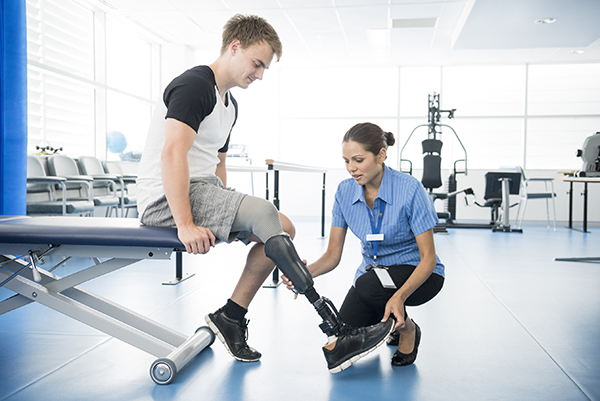
Amputee Clinics/Centers provide multidisciplinary, specialized care for individuals with limb loss, offering services like surgical consultation, wound care, prosthetic fitting and training, physical and occupational therapy, and mental health support to help patients regain function and adjust to life with an amputation.
These centers aim to provide seamless, comprehensive care under one roof, addressing patients’ physical and psychological needs and guiding them through recovery to maximize independence and confidence.
Key Services Offered
Surgical Care: Teams include surgeons who perform amputations or reconstructive procedures, focusing on preparing the residual limb for a prosthesis.
Wound Care: Essential for healing the residual limb, which must be healthy and fully cured before a prosthetic device can be fitted.
Physical and Occupational Therapy: Therapists provide exercises to strengthen and stretch muscles, improve balance, and train patients to use their prosthetics for walking and other daily activities.
Prosthetic Management: A certified prosthetist works with the patient to select, fit, and provide training for artificial limbs (prostheses) to ensure optimal fit and function.
Mental Health and Psychological Support: These centers provide emotional and psychological support to help patients cope with the loss of a limb, navigate changes in confidence, and transition back to their community and activities.
Rehabilitation Management: A physiatrist (a specialist in rehabilitation medicine) or other healthcare professional evaluates the patient and coordinates all aspects of care.
Limb Preservation: For some patients, clinics also evaluate options to save the limb through reconstruction or other methods, rather than amputation.
Research and Community Resources: Many centers conduct research, offer prenatal evaluations for limb differences, and connect families to peer support groups and other community resources.
Goals of an Amputee Clinic
Provide coordinated, multidisciplinary care from various specialists in one location.
Promote healing and recovery in a structured environment.
Maximize functional independence and mobility.
Please provide the correct prosthetic device and train the patient to use it effectively.
Offer emotional strength and confidence to the patient and their family.
Facilitate a smooth transition: back to home, work, and desired activities.