
HealthProviders DB is a comprehensive database of healthcare providers, including a complete directory of all Pulmonary Function Technologists.
Certified Respiratory Therapist Healthcare Taxonomy Code 2278P1006X
As of today, the following are the total number of Pulmonary Function Technologists nationally, in your State, and near your location.
Select a State below to view the list by State. Additionally, you can narrow the list by city, among other options, from the Filter Panel, which you can open by clicking the vertical ellipses ⋮ in the upper right corner of the app.
Alaska – Alabama – Armed Forces Pacific – Arkansas – American Samoa – Arizona – California – Colorado – Connecticut – District of Columbia – Delaware – Florida – Federated States of Micronesia – Georgia – Guam – Hawaii – Iowa – Idaho – Illinois – Indiana – Kansas – Kentucky – Louisiana – Massachusetts – Maryland – Maine – Marshall Islands – Michigan – Minnesota – Missouri – Northern Mariana Islands – Mississippi – Montana – North Carolina – North Dakota – Nebraska – New Hampshire – New Jersey – New Mexico – Nevada – New York – Ohio – Oklahoma – Oregon – Pennsylvania – Puerto Rico – Palau – Rhode Island – South Carolina – South Dakota – Tennessee – Texas – Utah – Virginia – Virgin Islands – Vermont – Washington – Wisconsin – West Virginia – Wyoming
Medicare & Medicaid Exclusions
The following are the total number of Pulmonary Function Technologists who accept Medicare in your State, the number who have opted out of Medicare, and the total number excluded from participation in Medicare nationwide.
The diagram below shows all the Pulmonary Function Technologists across the country, represented by blue bubbles. The larger the bubble, the greater the concentration of providers in that area. Red bubbles represent Medicare-excluded providers, with the larger bubbles indicating a higher percentage of excluded providers in that region. You can change the bubble size to be based on exclusions from the Size menu.
What do Pulmonary Function Technologists do?
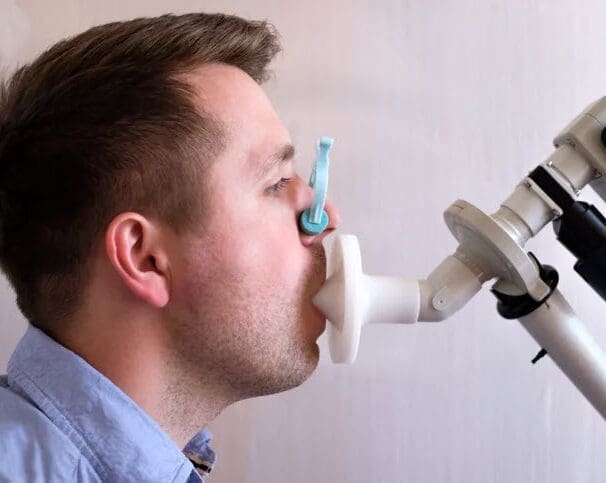
Pulmonary Function Technologists, a specialization for Certified Respiratory Therapists (CRT), perform diagnostic tests to evaluate lung function, including spirometry and gas-exchange tests.
They prepare patients for these tests, ensure equipment is functioning correctly, analyze results, and help physicians diagnose and manage respiratory conditions such as asthma and COPD.
They also provide patient education, perform noninvasive pulmonary care, and may be involved in pulmonary rehabilitation.
What they do
Diagnostic testing: Conduct a variety of tests, including spirometry, lung volume and diffusion capacity tests, and bronchial provocation tests.
Patient preparation and education: Explain the purpose of tests to patients, ensure they understand the process, and instruct them on correct breathing techniques.
Equipment operation and maintenance: Set up, operate, and maintain specialized equipment to measure lung volume, airflow, and gas exchange. They also ensure the equipment is calibrated correctly.
Data analysis and reporting: Analyze test data to identify abnormalities and report findings to physicians to aid in diagnosis and treatment decisions.
Patient care: Monitor and assess patients’ ability to exchange gases, provide noninvasive care, and assist with pulmonary rehabilitation.
Troubleshooting: Identify and resolve issues with equipment and patient performance during testing.
Required skills
Technical proficiency: Skilled in operating and maintaining a variety of pulmonary function testing equipment.
Analytical skills: Able to interpret complex data and identify abnormalities in breathing patterns.
Communication: Effectively explain complex medical procedures to patients and families.
Compassion and empathy: Work with patients experiencing breathing difficulties, often requiring a compassionate approach to build trust.
Attention to detail: Meticulous monitoring of equipment and patient responses is crucial for accurate results.